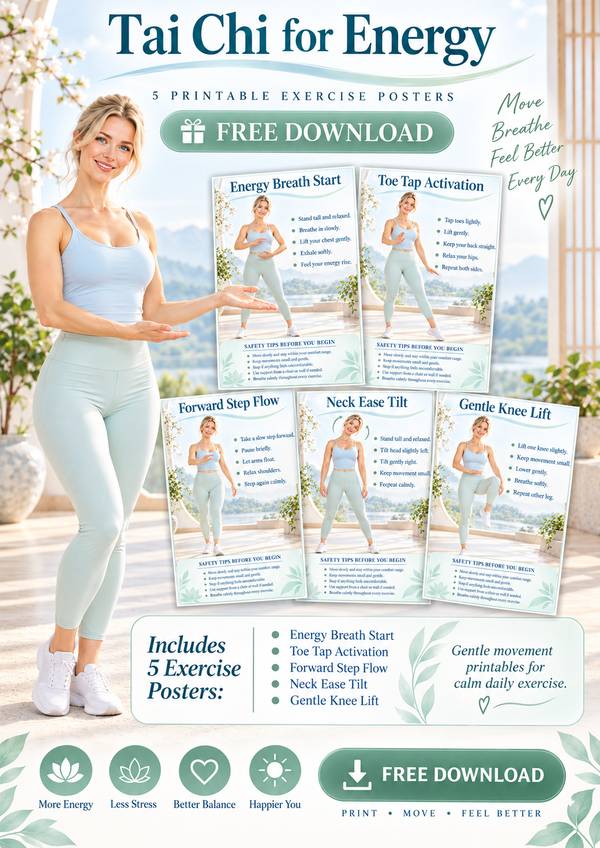
Tai Chi is a gentle form of movement that brings together posture, breathing, balance, and flowing exercise. Although it is often associated with relaxation, Tai Chi can also be a useful way to feel more awake, mobile, and physically refreshed.
For people who do not enjoy intense workouts, fast-paced routines, or high-impact exercise, Tai Chi for energy offers a softer alternative. The movements are slow and controlled, yet they still encourage the body to move, shift weight, coordinate the arms and legs, and stay connected to the breath.
Rather than exhausting the body, Tai Chi aims to help movement feel smoother and more natural.
What Is Tai Chi for Energy?
Tai Chi developed from traditional Chinese movement practices and is often described as a form of moving meditation.
Many traditional teachings use the concept of “qi” or “chi,” commonly translated as life energy. In everyday terms, people may think of this as a feeling of vitality, alertness, balance, and overall physical wellbeing.
Tai Chi for energy focuses on movements that feel uplifting rather than demanding.
You might practise slow arm lifts, gentle stepping, weight shifts, heel presses, controlled reaches, shoulder movements, or breathing exercises.
The aim is not to move as far or as fast as possible.
The goal is to move smoothly, comfortably, and with awareness.
Why Gentle Movement Can Help You Feel More Awake
When you have been sitting for a long time or have just woken up, the body can feel heavy or stiff.
Gentle movement can help change that feeling.
A few minutes of controlled stepping, arm movements, or weight shifting can encourage the body to become more active without suddenly placing it under heavy physical demand.
You may notice your muscles warming, your posture becoming more upright, and your joints feeling easier to move.
This is one reason Tai Chi can work well as a morning routine or as a movement break during the day.
It provides activity without requiring a complicated workout.
Start With Your Breath
Breathing plays an important role in Tai Chi.
Many people breathe more shallowly when they are tense, concentrating intensely, or sitting for long periods. Tai Chi encourages you to notice your breathing and allow it to become calmer and more regular.
A simple starting exercise is the Energy Breath Start.
Stand comfortably with your feet planted securely.
Relax your shoulders.
Breathe in slowly without forcing the breath.
Allow the chest to lift gently.
Then exhale softly.
Repeat several times.
There is no need to make each breath extremely deep. Comfortable breathing is more important than trying to take the biggest breath possible.
Let the Arms Begin to Flow
Arm exercises can make Tai Chi feel particularly relaxing.
Try standing tall while allowing both arms to rise slowly in front of you.
Stop at a comfortable height and then allow them to lower again.
You might also gently sweep one arm across the body, reach forward, or open both arms outward.
Keep the elbows soft rather than locked.
Let the shoulders remain relaxed.
The movements should feel smooth rather than sharp.
Imagine that your arms are moving through water. This can help encourage a slower and more controlled rhythm.
Wake Up the Feet and Legs
Energy-focused Tai Chi does not only involve the upper body.
The feet and legs are equally important because they support balance and help you move from one position to another.
Simple movements might include:
- Toe taps
- Heel presses
- Small knee lifts
- Gentle side steps
- Slow forward steps
- Weight shifts
- Foot circles
These exercises can be kept very small.
For example, a toe tap does not need to involve a large step. Simply transferring some weight onto one leg and lightly touching the other foot forward can be enough.
If your balance is uncertain, practise near a stable chair, bench, or wall.
Discover the Power of Weight Shifting
One of the foundations of Tai Chi is learning to shift your weight gradually.
Stand with your feet comfortably apart.
Keep your knees relaxed.
Slowly move a little more weight toward your left side.
Return toward the centre.
Then move gently toward the right.
Avoid leaning dramatically.
Instead, think of the body gliding from one side to the other.
Once this feels comfortable, you can add arm movements.
For example, allow one arm to float outward as your weight shifts, then slowly return.
These combinations create the flowing appearance commonly associated with Tai Chi.
Use the Whole Body Together
Tai Chi movements become more interesting when several parts of the body begin working together.
A forward step may be combined with a gentle arm reach.
A sideways weight shift can accompany an arm sweep.
A knee lift may be paired with relaxed hand positioning.
The movement should still feel comfortable and controlled.
Coordination develops gradually. There is no need to immediately perform long sequences.
Begin by learning one movement at a time.
Once you feel confident, link two exercises together.
Eventually, several simple movements can become one continuous routine.
A Gentle Morning Energy Routine
If mornings often begin slowly, a short Tai Chi routine can provide a calm transition into the day.
You could try the following sequence:
- Stand comfortably and take several slow breaths.
- Raise and lower the arms gently.
- Roll the shoulders slowly.
- Shift your weight from side to side.
- Perform several light toe taps.
- Take a few controlled forward steps.
- Open the arms gently to the sides.
- Finish with several calm breaths.
There is no requirement to complete a particular number of repetitions.
Five to ten minutes can be enough for a simple introductory routine.
Tai Chi as a Movement Break
Tai Chi can also fit easily into everyday life.
You do not always need a full workout session.
If you have been sitting at a computer, stand up and perform several gentle shoulder rolls.
If your legs feel stiff, try slow heel presses or weight shifts.
If you need a mental break, practise slow arm movements while breathing comfortably.
Even a short movement break can help interrupt long periods of inactivity.
The simplicity of Tai Chi makes it particularly useful when you only have a few minutes available.
Keep the Movements Comfortable
Tai Chi should never become a competition to see who can stretch the furthest or balance the longest.
Comfort and control matter more than range.
Keep movements small if necessary.
Use support if you feel unsteady.
Avoid forcing stiff joints.
Stop if you experience pain, dizziness, unusual breathlessness, or another concerning symptom.
People with significant balance problems, injuries, recent surgery, or medical conditions may wish to speak with an appropriate healthcare professional before starting a new exercise routine.
Creating Your Own Tai Chi Energy Flow
One of the advantages of Tai Chi-inspired exercise is that you can build a routine gradually.
Start with movements you enjoy.
You might combine:
- Energy breathing
- Arm floats
- Shoulder rolls
- Forward reaches
- Side steps
- Knee lifts
- Heel presses
- Toe taps
- Gentle walking
- Weight shifting
Practise each movement slowly before transitioning into the next.
Over time, the pauses between exercises can become smaller.
Instead of stopping after each movement, you begin flowing naturally from one position into another.
This sense of continuous movement is one of the most enjoyable parts of Tai Chi.
Unlocking Vitality Through Flow
Feeling energetic does not always require harder exercise.
Sometimes the body responds well to something gentler.
Tai Chi encourages you to stand taller, breathe more calmly, move your joints, activate your muscles, shift your weight, and pay attention to how your body feels.
It can be practised at home, outdoors, or almost anywhere with enough clear space.
There is little equipment required, and movements can often be adapted to suit different ability levels.
Most importantly, Tai Chi reminds us that exercise does not have to leave us exhausted to be worthwhile.
Sometimes a few minutes of calm, flowing movement is exactly what the body needs to feel more mobile, refreshed, and ready for the rest of the day.
Frequently Asked Questions
1. Is Tai Chi good for boosting energy?
Tai Chi may help some people feel more refreshed by combining gentle physical activity, controlled breathing, posture, concentration, and relaxation. The experience is usually more calming than stimulating.
2. Can beginners practise Tai Chi for energy?
Yes. Beginners can start with very simple exercises such as breathing, arm lifts, weight shifts, toe taps, and slow stepping before learning longer sequences.
3. How often should I practise?
Short regular sessions can be a practical starting point. Some people enjoy five to ten minutes each day, while others prefer several longer sessions during the week.
4. Can Tai Chi be adapted if I have poor balance?
Many movements can be made smaller and practised near a stable chair or wall. People with significant balance difficulties should consider professional guidance before beginning.
5. What should I wear for Tai Chi?
Choose comfortable clothing that allows easy movement and supportive footwear appropriate for the surface you are practising on.